art watchers art card
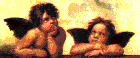
Detail of Raffaels "Madonna sixtina" (Galerie Alter Meister, Dresden, Germany)
Make your own artistic art card
What you need:
(beside your computer and printer)
cardboard, two pencils (hard and soft graduation, f.e. F-2H and 3-6B)
Instruction
1. Download the picture (the gif) and print it.
You can also make a copy of the picture you prefer.
(Switch off your computer!)
2. Blacken the back of the print with the soft pencil.
(You can also hatch the back in different colours.)
3. Put it (carefully) with the back down onto the cardboard.
4. Sketch onto the print with high pressure, orientating yourself by the picture.
(You can combine contour and hatching or add something, like I've done.)
5. Look at the cardboard.
Elaborate the drawing on it with the pencils or colour it.
(You can also add some gold, perhaps at the wings. A sheet of gold is not so expensive. Put on some glue at the selected parts of the drawing before slightly pressing the sheet of gold onto it.)
THE END
It looks like an original drawing (not like a copy).
You can do something similar with a painting-programm, too, but it's not the same.
It's another look and feel.
Do it by hand!

art watchers home
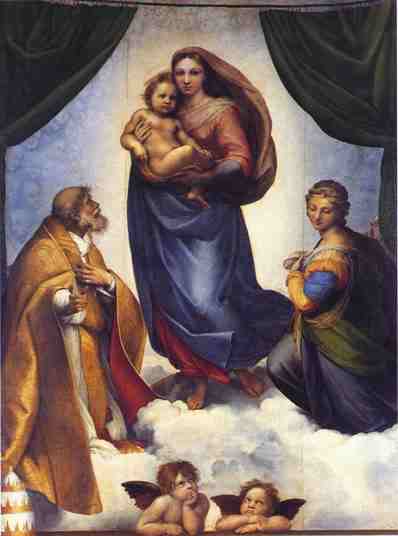
Madonna Sixtina - Santi Raffael
|
A short look at the original
The popular cherubs are a detail of the painting "Madonna Sixtina"(Madonna di San Sisto, 1513/14) by Raphael (Santi Raffael/Sanzio Raffaelo, 1483-1520), one of the most famous artists of the Italian Renaissance. You see 'Mary with child (Jesus)' sublime floating on clouds in a stage-like scenery (with drawn curtains). At her sides two persons are arranged in a triangular composition - on the left Saint Sixtus (Sisto or Xystus), looking up to Jesus, on the right Saint Barbara, looking down, at their feet the angels mentioned before, looking gravely out of the picture. The child (Jesus Christ) looks astonishingly grown-up, serious, with tousled hair and an athletic anatomy. Mary, however, looks relatively young - virgin. The background of the painting is made up by shadowy mask-like faces. (Heads of angels or death masks?) For centuries this picture has fascinated not only art historians, because they saw themselves faced with a mystery. Where are Jesus, Mary and the cherubs looking? Where is Sixtus pointing? Why is there such a despairing look in the protagonists' eyes? Originally the choir cross must have hung opposite the picture (in the monastery S.Sisto in Piancenza, Italy) above the 'Lettner' ( a barrier in churches until the 16th century to separate the choir from the rest of the church). Jesus as well as Mary perceive 'Jesus on the cross', the destiny awaiting, the tale of woe - Christ's passion, which Sixtus is also refering to. Birth and death are linked as inseparable aspects of life in this painting. |
Sixtinische Madonna (256*196cm) Look at a good reproduction in a book or better visit the 'Galerie Alter Meister', Dresden, Germany. Remember! The resolution of a gif or jpg in the internet is only 72 dpi, a reproduction on art paper - 2540 dpi. Even this never matches the quality of an original painting, f.e. the transparency of the colours.
|
Ein kurzer Blick auf das Original
Die populaeren Engelchen (Putten) sind ein Ausschnitt aus dem Gemaelde "Sixtinische Madonna" (Madonna di San Sisto, 1513/14) von Raffael (Santi Raffael/Sanzio Raffaelo, 1483-1520), einem der bekanntesten Kuenstler der italienischen Renaissance. Es zeigt 'Maria mit dem Kind' erhaben auf Wolken 'schwebend' in einer buehnenartigen Kulisse (mit aufgezogenen Vorhängen). Zu ihren Seiten sind zwei Personen in einer Dreieckskomposition angeordnet - links der heilige Sixtus (auch Sisto oder Xystus), zu Jesus aufblickend, rechts die heilige Barbara, unter sich schauend. Zu ihren Fuessen, am unteren Bildrand befinden sich die besagten Putten, ernst aus dem Bild blickend. Das Kind (Jesus Christus) sieht ungewoehnlich erwachsen aus (mit ernstem Blick, zerzaustem Haar und durchgebildeter Anatomie), Maria dagegen recht jung - jungfraeulich. Der Hintergrund des Gemaeldes wird von schemenhaft auftauchenden, maskenhaften Gesichtern gebildet. (Engelskoepfe oder Totenmasken?) Das Bild hat, nicht nur Kunstgeschichtler, ueber Jahrhunderte hinweg fasziniert, da es einige Raetsel aufgibt. Wohin schauten Jesus und Maria, sowie die Engel? Wohin zeigt Sixtus? Warum der verzweifelte Blick der Hauptpersonen? Gegenueber des Bildes hing wohl urspruenglich (in der Klosterkirche S. Sisto in Piacenza) das Chorkruzifix (-kreuz) ueber dem Lettner. Jesus, wie Maria erblicken 'Jesus am Kreuz', das zu erwartende Schicksal - die Leidensgeschichte. Geburt und Tod werden als untrennbare Aspekte des Lebens in diesem Gemaelde verknuepft. |
|
thankks to
the Kunstsammlung Dresden for the permission to reproduce
the original painting |
Make an ArtCard with the cherubs!
art watchers home
Copyright © Reiner Strasser 1996/97. All rights reserved.
|
Annotations
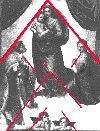
Triangular Composition The triangular composition, which is repeated several times in the picture, was very common at that time. Showing a hierarchy it radiates a sense of harmony and calm, and refers symbolically to the Holy Trinity. |
|
Anmerkung
Dreieckskomposition Die Dreieckskomposition, die sich mehrfach im Bild wiederholt, war in der damaligen Zeit sehr verbreitet. Eine Hierarchie anzeigend, strahlt sie Harmonie und Ruhe aus und verweist symbolisch auf die goettliche Dreifaltigkeit. |