dumbnail.gif)
Colour
Basics - Itten and Runge
|
Every theory of colours tries to find elementary/basic rules of colours and their effect, to make the handling of colours easier. The first step is to determine the socalled primary colours, with which one can mix any other shade. In contrast to physics the primary colours in painting are yellow, red and blue. (In physics red, green and blue - look at your RGB-monitor.) This results from the different methods of mixing colours. In physics it's common to use the additive principle, in painting the subtractive one. |
Jede Farblehre versucht elementare Gesetze der Farbe und Farbwirkung zu finden, welche den Umgang mit Farbe erleichtern sollen. Der erste Schritt besteht in der Festlegung der sogenannten Grundfarben oder Primaerfarben, aus denen sich jeder Farbton mischen laesst. In der Malerei geht man im Gegensatz zur Physik von den drei Primaerfarben Gelb, Rot und Blau aus. (In der Physik Rot, Gruen und Blau - schauen Sie auf ihren RGB-Monitor.) Dies resultiert aus den unterschiedlichen Arten der Farbmischung. In der Physik verwendet man in der Regel die additive und in der Malerei die subtraktive Farbmischung. |
|
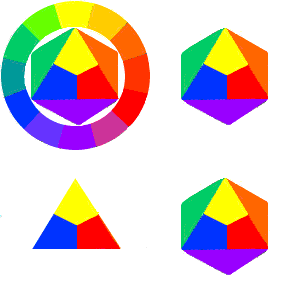
The Colour Wheel of Itten Johannes Itten, known as a master (Meister) of the Bauhaus , developed his Colour Wheel in the 30ies. It consists of twelve pure colours. Beginning in the middle of the circle you can find first the three primary colours yellow, red and blue. They are followed by the secondary colours, which are created by mixing two primary colours, e.g. yellow and red = orange. In the outer ring you can find the tertiary colours, beside the primary and secondary ones. These are created by mixing one primary colour with a neighbouring secondary colour, e.g. yellow and orange = yellow-orange. |
|
Johannes Itten, bekannt als Meister des Bauhauses , entwickelte in den 30er Jahren seinen Farbkreis. Er besteht aus zwoelf reinbunten Farben. Von der Mitte des Farbkreises ausgehend finden wir zuerst die drei Primaerfarben Gelb, Rot und Blau. Es folgen die Mischfarben erster Ordnung, die Sekundaerfarben, die sich aus der Mischung von jeweils zwei Grundfarben ergeben, z.B. Gelb und Rot = Orange. Im aeusseren Kranz sind die Primaer- und Sekundaerfarben um die Mischfarben zweiter Ordnung, die Tertiaerfarben erweitert. Diese ergeben sich aus der Mischung von jeweils einer Primaerfarbe mit einer benachbarten Sekundaerfarbe, z.B. Gelb und Orange = Gelborange. |
|
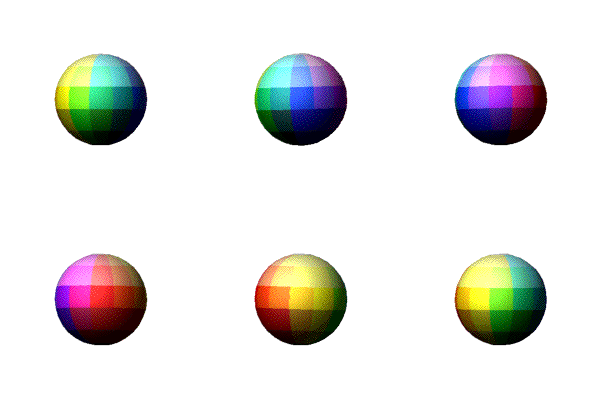
The Colour Ball of Runge Philipp Otto Runge, an artist of the German Age of Romanticism , developed the colour ball in the 19th century. The pure colours - the primary, secondary and tertiary colours (look above - Itten) are arranged around the equator. Towards the poles these colours are lightened or darkened in three steps (the pure colours are mixed with white or black). In contrast to Itten's Colour Circle the scale of colours on the surface of the ball has grown. You can see several shades of brown. (In his theory of colours Itten also used more than the colours of his Colour Circle.) |
|
Runges Farbkugel Philipp Otto Runge, ein Kuenstler der deutschen Romantik , entwickelte im 19. Jahrhundert die Farbkugel. Um den Aequator sind die reinbunten Farben, die Primaer-, Sekundaer- und Tertiaerfarben (vgl. Ittens Farbkreis), angeordnet. Diese werden in den sich ergebenden zwoelf Meridianstreifen zu den Polen hin in drei Stufen aufgehellt bzw. abgedunkelt (mit Weiss bzw. Schwarz abgemischt). Gegenueber Ittens Farbkreis erweitert sich damit die Farbskala an der Oberflaeche der Kugel unter anderem um verschiedene Brauntoene. (In seiner Farbtheorie verwendete auch Itten mehr Farben als die seines Farbkreises.) |
|
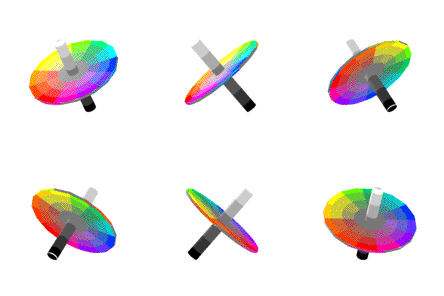
Inside the ball there are further mixed colours. From the north to the south pole you find a scale of seven shades of grey. |
|
Im Innern der Kugel finden sich weitere Farbmischungen. Von Nord- zum Suedpol laeuft eine Grauskala mit sieben Graustufen. |
|
Today cyan, magenta and yellow are used as the primary colours. You can find them e.g. in printing technology (CMY + K, black, to get a better contrast, the darker colour tones and the colour black for itself). |
Heute sind Cyan, Magenta und Gelb die aktuellen Grundfarben, die unter anderem im Druckwesen wiederzufinden sind (CMY + K, Schwarz, zur Verstaerkung der Kontraste, zur Erzeugung dunkler Farbtoene und von Schwarz selbst). |
|
You can compare the different colour schemes below. |
Zum Vergleich folgen die verschiedenen Farbschemata. |
|
Colours used by Itten in his Colour Wheel (scanned from reprints of Itten's palette with 24bit)
| |
|
CMY - Cyan, Magenta and Yellow (generated with Photoshop)
| |
|
Red, Green and Blue (of your monitor) (generated with Photoshop)
| |
Part 2 / The Complementary Contrast

art.)watchers
home
-
Free for educational use only -
Copyright © R.Strasser . 1996/97. All rights reserved.